Skip to content

Just like other countries standardize their healthcare systems by evaluating professionals through organized channels, including tests and practical demonstrations, the UAE also uses a similar professional assessment system. This system is organized and regulated by the federal authority MOHAP, following global healthcare standards, and includes a mandatory computer-based test known as the MOH Exam or Ministry of Health Exam. It is conducted by the UAE Ministry of Health and Prevention (MOHAP) through different channels, such as Prometric, to assess clinical knowledge, practical skills, ethical conduct, and patient safety standards.
All healthcare professionals, including doctors, dentists, nurses, pharmacists, and allied health workers, have to pass it to get licensed and work legally in regions of the UAE that are regulated by the MOHAP. However, exceptions are there for certain qualified professionals, including doctors with recognized specialty certificates, dentists who passed ADC or NBDE, and many more, which we have discussed below. To appear for the MOHAP exam, non-exempt candidates must meet basic eligibility conditions, including having a relevant degree or diploma, a source country license, a passport, and an ID.
Once you are eligible, the actual process for test registration gets started, where you have to create a MOHAP portal account, complete PSV, book the exam, and pay the fee. Once everything is done, you have to follow the timing and exam centre regulations to ensure legal compliance. Once you appear for the exam, you will be provided with the results within a few days as a clear pass or fail status.
The passing score depends on the professional role; however, in general, the required percentage is 60%. After successfully passing the exam, you have to get the license within one year; otherwise, it will expire, and you have to reappear. But if you fail, don’t worry, MOHAP offers three attempts for every candidate, which you can avail yourself of to get and work in the UAE.
This guide has covered the MOH exam requirements, registration, fees, eligibility, exemptions, exam format, syllabus, and preparation tips. However, if you feel less confident with the process, feel free to contact our expert to help you understand the testing process, which will save you time and money.
What is the MOH Exam in the UAE?
The MOH Exam is a mandatory computer-based multiple-choice test administered by the Ministry of Health and Prevention (MOHAP) through approved testing centers, such as Prometric, to assess healthcare professionals’ medical knowledge, practical skills, professional values, and patient safety standards for ensuring safe and effective patient care in the UAE under the Ministry of Health and Prevention. Doctors, nurses, dentists, pharmacists, and allied staff must pass this examination if they need to get a MOHAP medical licensure and want to work in the UAE after they meet national healthcare rules and practice safely in approved medical facilities.
Who Conducts the MOH Medical License Exam?
The MOH Medical License Exam is conducted by the Ministry of Health and Prevention (MOHAP) of the United Arab Emirates as a part of a healthcare professional’s pathway to licensure. The Ministry sets the rules, creates the test content for examinees, and oversees exam delivery through authorized test centers to run the exams in secure settings. Established in 1971, the very same year the UAE was formed, with a purpose to grant a license to physicians after analyzing their clinical and educational capabilities, to inquire into patient complaints, and to regulate the healthcare system to operate under the federal law.
Why is the MOH Exam important?
First and foremost, the MOH exam is important for High-quality assessments of the healthcare professionals, including both medical knowledge and the right clinical skills, no matter where they were trained, except for some, who are exempted by the UAE officially. In fact, the World Health Organization (WHO) regulatory principles also endorse national licensing examinations as a means to ensure standards of knowledge, clinical competence, and ethical practice for greater patient care.
Second, it makes sure to only allow the top-class workers by filtering incompetent professionals through this competency evaluation test. Thirdly, and most importantly, patient trust in the UAE healthcare system is built by prioritizing patient care. This is achieved by allowing healthcare professionals to practice only in the specialty in which they are examined, ensuring patient-problem-focused treatment.
What Are the Eligibility Criteria for the MOH Exam?
The eligibility criteria include holding a recognized degree, possessing a minimum of two years of professional clinical experience, and having a valid, good-standing certificate issued by a previous employer or regulatory authority within the last six months. The eligibility clearance helps professionals to save themselves from extra efforts if they are not ready for the professional testing ahead. However, the main eligibility criteria differ by profession, while the core rules provided below stay the same.
Main Eligibility Requirements:
- Degree from a Recognised University
- At Least 2 Years of Professional Experience
- Good Standing Certificate
- A medical license from the native country
- The Primary Source Verification of all the educational requirements
- No major practice gaps beyond allowed limits
Who Is Exempted from the MOH Exam?
Some healthcare professionals do not need to sit for the MOH exam if they meet the exemption rules set by MOHAP. These exemptions apply to experienced practitioners with strong credentials. The goal is to avoid repeat testing while maintaining patient safety. Approval depends on documents, experience level, and current license status.
Exempted categories as per the PQR are provided in the table provided below.
| Profession | Exemption Criteria | Notes / Conditions |
|---|---|---|
| Doctors / Physicians | UAE nationals, children of Emirati women, or holders of recognized specialty certificates / valid international licenses | Children of Emirati women must show a birth certificate & mother’s family book; the exemption applies only to the exam |
| Dentists | Valid registration or passed recognized exams (ADC, NDEB, NZDREX, ORE/GDC, NBDE, EDEE) | Must meet criteria for practice, teaching, sub-specialty, research, and clinical publications |
| Nurses / Midwives | Valid license and Good Standing Certificate (GSC) from approved countries; NCLEX required for USA, Canada, Australia | English proficiency required if studies/licensure are not in English |
| Paramedics / EMTs | Valid license and GSC from Australia, Canada, New Zealand, USA; required degree, certification, and internship | Must meet country-specific education and practice rules |
| Medical Laboratory Technologists | Valid license and GSC from approved countries; ASCP required for the USA | Qualification must be recent (≤3 years) or have no gap in practice |
| Pharmacists / Clinical Pharmacists | Valid license and GSC from approved countries; UAE candidates must pass EPREE | Exemption applies only to the licensure exam |
What Are the Requirements for the MOH Exam?
The requirements for the MOH exam ensure that applicants are qualified, verified, and ready for safe medical practice in the UAE. MOHAP reviews documents, experience, and professional history before exam approval. Fulfilling these requirements helps avoid delays, rejections, or repeated submissions during the licensing process.
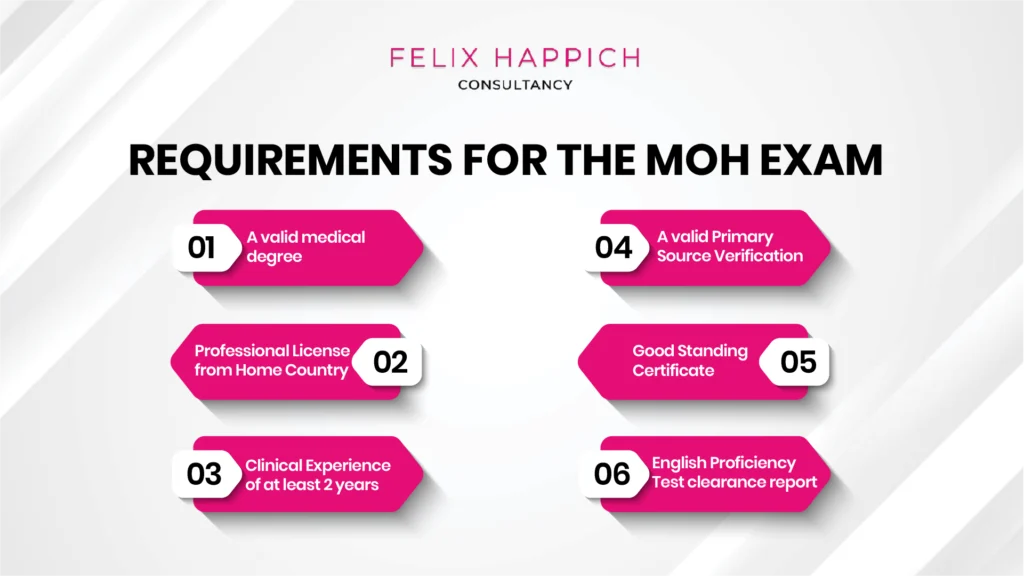
The key requirements are provided below.
Educational Qualification:
Medical or healthcare degree (MBBS, BDS, Pharm.D, Nursing, etc.) from a recognized university. Degree must meet UAE equivalency standards.
Professional License / Registration:
Hold a valid license or registration in your country of practice (if applicable).
Experience:
Some specialties require clinical experience. For consultants or specialists: 10+ years of practice, including at least 2 years in a teaching hospital.
Primary Source Verification (PSV):
All documents must be verified by the relevant authorities to ensure authenticity.
English Language Proficiency:
Required to have a valid English proficiency test pass. Accepted proofs are:
- TOEFL ≥ 500
- IELTS ≥ 5.0
- OET ≥ C
- Cambridge Assessment English ≥ 169
What Documents Are Required for an MOH Exam?
The documents required for the MOH exam include a recognized degree, a valid license, experience proof, good standing documents, ID, and photos, English proficiency (if required), to prove your identity, education, and professional history. Clear, valid documents help you have a smooth MOH exam registration. Here are the documents you’ll need while applying for the exam. However, missing or incorrect documentation often causes delays.
Required documents
- Passport copy
- Recent passport-size photograph
- Educational certificates
- Professional license
- Experience letters
- Good standing certificate
- Primary Source Verification Report
How to Apply for the MOH Exam?
To apply for the MOH Exam, you need to create an account on the MOHAP Smart Services website. After the account is active, you have to go to the evaluation section. You have to select the right speciality where you want to offer services. After this, you have to upload all the mentioned documents, as they will do the Primary Source Verification (PSV) process, where DataFlow checks your education and work experience.
When this verification is completed, MOHAP allows you to move forward and book your exam through the Prometric portal, where you can view test centres and choose a suitable date.
The final step is completing the exam fee payment, which is done either on the MOHAP portal or directly through Prometric during the booking process. The detailed process is explained below:
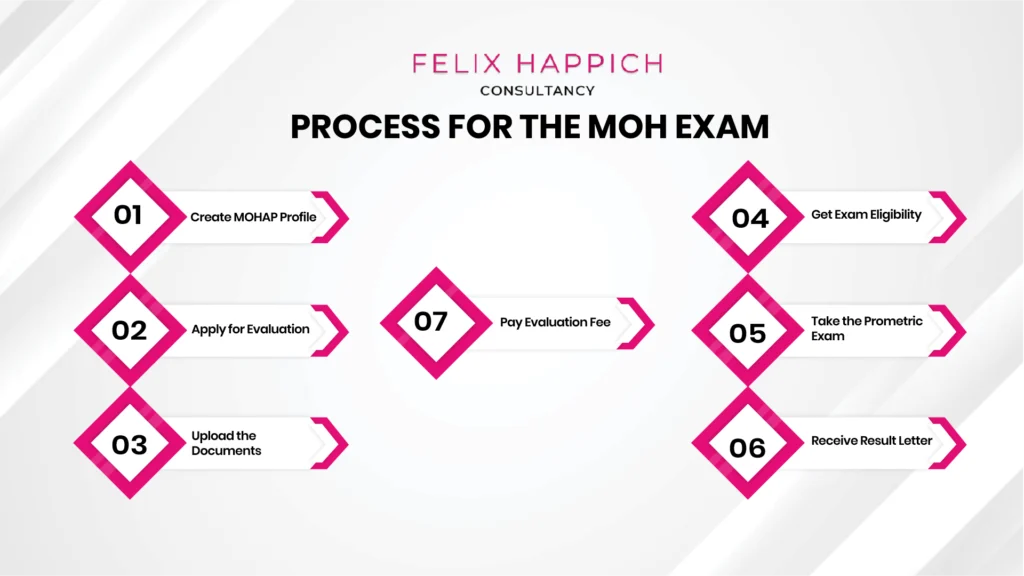
7 Steps Registration Process:
Below is the complete 7-step exam registration process, which you have to follow.
1. Create your online profile (MOHAP portal)
First, you go to the MOHAP Smart Services website and log in using UAE PASS. This creates your official profile and gives you access to the Health Professional Evaluation service.
2. Apply for Health Professional Evaluation
Before any exam, you must submit a Health Professional Evaluation application. MOHAP checks your qualification, experience, and documents to decide if you even need the exam.
3. Upload your documents
Now you upload your documents. This includes your degree, experience letters, good standing certificate, passport, and ID. These documents are also verified through DataFlow.
4. Pay the evaluation fee
After uploading documents, you pay the MOHAP evaluation fee. Without payment, MOHAP will not review your application or issue exam eligibility.
5. Get exam eligibility and pick your exam date
If MOHAP decides you need an exam, they issue an eligibility ID. Using that ID, you book your Prometric exam and choose a suitable exam date.
6. Prepare and take the exam
You prepare using official MOHAP exam topics and then sit for the exam at an approved Prometric center. You have a maximum of three attempts.
7. Get your result and apply for the MOH license
Once you pass, MOHAP issues an evaluation result letter. After that, you can continue with the MOH professional license process and legally work in the UAE.
How Much Does the MOH Exam Cost?
The MOH exam cost depends on the profession and application stage. On average, exam fees range from AED 200 to AED 500. For instance, the evaluation fee is AED 500 for physicians and dentists, AED 400 for nurses and midwives, and AED 300 for TCAM and allied health professionals. Extra charges may apply for Primary Source Verification, rescheduling, or document review, depending on individual case requirements.
What is the format of the MOH Exam?
The MOH Exam is a three-hour-long evaluation test with 100-150 questions. The passing score is 60 percent for most of the healthcare categories.
| Exam Detail | MOHAP Exam Information |
|---|---|
| Exam Type | Computer-based test |
| Question Format | Multiple-choice questions (MCQs) |
| Number of Questions | 100–150 (varies by profession) |
| Exam Duration | 2–3 hours |
| Passing Score | 60% |
| Exam Language | English |
How to check an MOH exam result?
You can check your MOH exam result online through the official MOHAP website or the MOHAP smart app. Results appear after evaluation. You need your account details. The system shows a pass or fail status clearly. No email delay usually occurs.
What Is the MOH Exam Passing Score?
The MOH exam passing score is usually 60 percent for most healthcare professions. Some categories may have slightly different benchmarks. MOHAP sets the score to ensure safe clinical practice. You must meet or exceed this mark to move forward with licensing. And the unique approach here is that you will not be provided with individual question results is as only pass or fail is mentioned in the results section.
How Long Are MOH Exam Results Valid?
MOH exam results remain valid for two years from the passing date. During this period, you can use the result to apply for an MOH medical license, and if you don’t apply for licensing or employment within this time, you have to retake the exam.
What Are the Next Steps After Passing the MOH Exam?
After passing the MOH exam, you move into the licensing stage. MOHAP checks final documents and eligibility before approval. This phase links your exam success to legal practice rights in the UAE.
How to better prepare for the MOH License Exam?
To prepare for the MOH exam, you can start by reviewing the official syllabus provided by the MOHAP to know exactly what to focus on. Along with this, you can participate in Prometric-style mock tests with full 150-question sets to improve your timing. In short, regular practice and updated study material help you get the maximum chance of success.
What Are the Common Reasons for MOH Exam Failure?
Many candidates fail the MOH exam due to weak preparation or poor exam strategy. Some rely only on memory. Others ignore clinical logic. Time pressure also affects results. However, this depends on individual preparation. Six of the most common reasons are provided below.
- Incomplete syllabus coverage
- Weak clinical concepts
- Poor time management
- Limited MCQ practice
- Guess-based answering
- Exam anxiety
What to Do If You Fail the MOH Exam?
Failing the MOH exam is not the end. Take a short break. Review your weak areas. Change your study plan. Practice more MCQs. Focus on clinical cases. Many candidates pass on the next attempt with a better structure.
Next steps
- Analyze exam feedback
- Identify weak subjects
- Revise core concepts
- Practice mock tests
- Reapply after the eligibility period
How many times can one retake the MOH Exam?
You can usually attempt the MOH exam up to three times. After three failed attempts, MOHAP imposed restrictions; however, this rule depends on profession and current MOHAP policies.
Professionals Specific Guide
What is the Difference Between MOH and DHA Exams?
MOH and DHA exams are both licensing tests, but differ in jurisdiction. MOHAP governs the whole UAE except Dubai and Abu Dhabi. DHA handles Dubai specifically. Exam content is similar but may vary in format, syllabus focus, and scoring. Transfer rules differ if moving between authorities. A detailed comparison is provided in the table below.
| Feature | MOH Exam | DHA Exam |
|---|---|---|
| Jurisdiction | Applies to MOHAP regions | Applies only in Dubai |
| Exam Type | Computer-based MCQ | Computer-based MCQ |
| Syllabus | Core clinical, ethics, and emergency care | Core clinical, ethics, and Dubai-specific guidelines |
| Verification | Primary Source Verification required | Primary Source Verification required |
| License Issuance | After passing the exam | After passing the exam |
| Transfer Rules | May transfer to DHA/DOH with conditions | May transfer to MOHAP/DOH with conditions |