Skip to content

Dental care in Dubai is regulated by the Dubai Health Authority (DHA), which oversees public-health rules, licensing standards, and clinical protocols in the Emirate, including communicable disease control as per Law No. 5 of 2025. All foreign-trained dentists must pass the licensing assessment before practicing in Dubai unless they qualify for exemptions under the PQR policy as per DHA guidelines.
The DHA conducts computer-based testing (CBT) for dentists and communicates eligibility decisions through the Sheryan portal, forming part of the unified licensing framework as mentioned in the Final_Online_Exam_Guideline_CBT, July 2024.
Prometric administers the CBT globally through approximately 8,000 test centers in over 160 countries. Typical exams have 150 multiple-choice questions to be completed in three hours according to the CBT guideline. Fees generally follow the DHA guideline (around USD 280 per test), though variations may exist as per the DHA guideline. DHA may update exam content, formats, or pass scores as needed, as mentioned in the guideline.
In short, we cover everything you need for the DHA dentist exam, from understanding the rules and registration process to fees, passing scores, and a full syllabus guide, to help you tackle the exam with confidence.
What is the DHA Exam for a Dentist?
The DHA exam for a dentist is a computer-based multiple-choice test consisting of 150 questions to be completed in three hours. It assesses clinical knowledge, diagnostic reasoning, emergency care, infection control, and specialty skills. Results are recorded as pass or fail in the Sheryan system (as per DHA CBT guideline).
Who Conducts the DHA Dental Exam?
The Dubai Health Authority sets exam policies, eligibility criteria, and licensure rules according to DHA licensing regulations. Prometric schedules and delivers the exams at global test centers as mentioned in the CBT guideline.
What are the eligibility criteria to appear in the DHA Dental Exam?
Eligibility for the DHA dental exam requires applicants to meet the Professional Qualification Requirements (PQR), which include holding a recognized dental qualification, completing mandatory internship training, and fulfilling the required clinical experience for their category. Candidates must also provide valid licensure, Good Standing, academic documents, and complete Primary Source Verification before scheduling the DHA assessment.
DHA Dental Exam Eligibility Summary Table
Minimum qualifications, experience, and practice levels are summarized below as per DHA PQR and CBT guidelines:
| Category | Minimum Qualification | Experience | Practice Level |
|---|---|---|---|
| General Dentist | BDS/DDS | 2 years | Independent |
| Specialist | Master’s/Board | 3 years | Specialist |
| Consultant | Fellowship/PhD | 5+ years | Consultant |
| Assistant | Diploma/Degree | 1–2 years | Support |
What are the DHA Exam Requirements for Dentists?
The DHA exam requirements for dentists include having verified qualifications, evidence of recent practice, and complete Primary Source Verification (PSV) through approved channels as per the DHA CBT guideline. Documents required include degree certificates, transcripts, national licenses, a passport, and Good Standing letters according to DHA PQR policy. DHA may amend or suspend requirements under public interest (following Law No. 5 of 2025).
Specialist Dentist
- Recognized postgraduate qualification (Master’s, Residency, or approved Board Certification).
- Minimum 3 years of accredited specialty training.
- Relevant post-specialty clinical experience as per DHA PQR.
- Submission of all specialty certificates.
- Case logs or surgical logs (required for specific specialties).
- Academic transcripts.
- Valid Good Standing Certificate (issued within 6 months).
- Completion of Primary Source Verification (PSV/DataFlow).
Consultant Dentist
- Advanced Board Certification, Fellowship, or equivalent consultant-level qualification.
- 5+ years of consultant-level clinical experience (depending on specialty and PQR).
- Proof of senior clinical, academic, or leadership responsibilities (if required).
- Valid Good Standing Certificate.
- Completion of PSV/DataFlow for all documents.
- Some consultant categories may require an oral assessment as part of the exam process.
Dental Hygienist
- Recognized diploma or bachelor’s degree in Dental Hygiene.
- 1–2 years of clinical experience, depending on DHA PQR.
- Academic transcripts and training certificates.
- Good Standing Certificate (if previously licensed).
- Completion of PSV/DataFlow.
- Standard DHA CBT exam format applies (150 MCQs, 3 hours).
Dental Assistant
- Recognized diploma or certification in Dental Assisting.
- 1–2 years of clinical experience (varies by country and training).
- Academic transcripts and training certificates.
- Good Standing Certificate (if applicable).
- Completion of PSV/DataFlow.
- Assessment follows DHA’s standard CBT format.
What is the DHA License Exam Fee for Dentists?
Most dentists’ CBTs are priced at USD 280 (as per DHA CBT guideline). Regional conversions may vary due to Prometric levies (according to DHA guidelines). Fitness screening services for residency visas cost AED 260–360 with a 24-hour issuance period (as mentioned in Examination of Medical Fitness for Residency Visa documentation). Candidates should confirm final fees when scheduling (as per DHA instructions).
| Category | Fee (AED) | Fee (USD) | Fee (INR) |
|---|---|---|---|
| General Dentist | AED ~1,030 | USD 280 | INR ~23,000 |
| Specialist Dentist | AED ~1,030 | USD 280 | INR ~23,000 |
| Consultant Dentist | AED 1,030–1,150 | USD 280–300 | INR ~23,000–25,000 |
| Hygienist/Assistant | AED ~900 | USD 240–280 | INR ~19,000–23,000 |
How to Apply for the DHA Dental Exam?
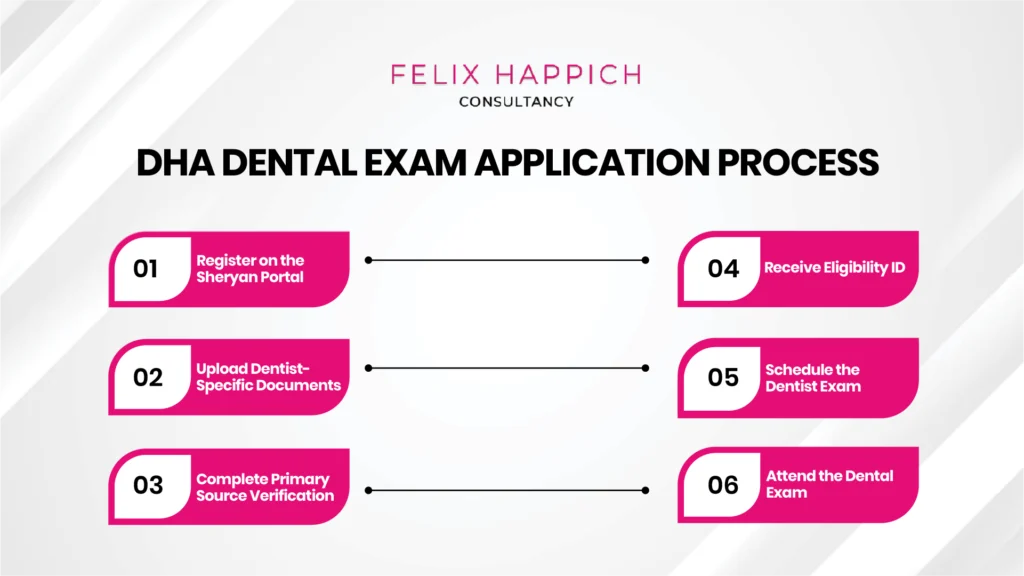
To apply for a DHA dental Exam, you have to register on the DHA Sheryan portal and confirm PQR eligibility (as per DHA guidelines). Then you have to upload key documents, including dental degrees, transcripts, passports, national licenses, and Good Standing letters. After this stage, initiate Primary Source Verification (PSV) and wait for the verification to finish according to the CBT guideline.
Once DHA approves the file, the system issues you a Unique ID along with an Eligibility ID. This Eligibility ID is what you will use to book the exam through Prometric, where fees are paid online as mentioned in DHA instructions. On the exam day, candidates must arrive with the required identification and supporting documents as per the CBT guideline. The main steps are provided below in detail:
- Register on the DHA Sheryan Portal
- Upload Dentist-Specific Documents
- Complete Primary Source Verification (PSV)
- Receive Unique ID and Eligibility ID
- Schedule the Dentist Exam Through Prometric
- Attend the Dental Exam
Register on the DHA Sheryan Portal
The process starts with creating an account on the DHA Sheryan portal. Dentists confirm their eligibility under the PQR framework as per DHA guidelines. It helps ensure that all personal and academic details match those on your official documents, allowing the review to proceed without delay.
Upload Dentist-Specific Documents
After registration, dentists upload the required files: BDS or DDS degree, internship proof, transcripts, national dental license, Good Standing letter, and passport copy. These items form the verification base according to the CBT guideline, and they must be accurate and clear.
Complete Primary Source Verification (PSV)
Once the documents are in place, dentists initiate PSV through DHA’s approved service. PSV checks the validity of your dental degree, internship training, and professional license. Progress to the exam stage only begins once PSV is fully completed as per the CBT guideline.
Receive Unique ID and Eligibility ID
When PSV and document review are approved, DHA issues both a Unique ID and an Eligibility ID. These numbers open the path to scheduling your dental exam, as mentioned in DHA instructions, and must be saved carefully.
Schedule the Dentist Exam Through Prometric
With the Eligibility ID ready, dentists can book the exam through Prometric. You choose a date, select a nearby test center, and pay the fee online. The booking becomes active only after the payment goes through, according to DHA instructions.
Attend the Dental Exam
On exam day, dentists arrive at the Prometric center with the passport used in the Sheryan application. Security rules, ID checks, and locker use are mandatory. Following these requirements is important as per the CBT guideline, since failure to comply can lead to cancellation of the 150-question dentist exam.
DHA Exam Exemptions for Dentists
Just like physician dentist also have an option to get into the emirate healthcare system without the DHA examination after fulfilling the required criteria, which is different for dentist position including Consultant Dentist, specialist dentist, and general dentist. However, final decisions are at the discretion of DHA (according to the CBT guideline).
Consultant Dentist Exemption Criteria
Consultant Dentists who can come and practice in dubai with out the dha promatic exam need to have recognized qualifications as per the DHA PQR, which are listed below. Along with the qualification, they must provide a certificate of experience from their most recent country of practice, which must be listed below, with a minimum duration of two years.
Additionally, a valid license of not less than 2 years duration, a good-standing certification attesting to your required practice certificate. The recognized examinations from different countries include.
Australia: Fellowship of the Royal Australasian College of Dental Surgeons
Canada: Evidence of passing the National Dental Specialist Examination (NDSE)
Ireland: Certificate of Completion of Specialist Training (CCST) in Dentistry and inclusion in the Irish Dental Council Specialist Register
New Zealand: Fellowship of the Royal Australasian College of Dental Surgeons
United Kingdom: Certificate of Completion of Specialist Training (CCST) and inclusion in the UK Dental Council Specialist Register
USA: American Board of Dental Specialties certification (boards approved by the American Dental Association)
Specialist Dentist Exemption Criteria
Specialist Dentists are exempt from the DHA licensure examination if they hold one of the recognized specialist qualifications listed below, along with meeting the DHA Professional Qualification Requirements.
Australia: Holders of the Fellowship of the Royal Australasian College of Dental Surgeons (FRACDS) in a recognized dental specialty are eligible for exam exemption.
Canada: Dentists who have successfully passed the National Dental Specialist Examination (NDSE) are exempt from the DHA exam.
Ireland: Dentists who hold a Certificate of Completion of Specialist Training (CCST) in Orthodontics or Oral and Maxillofacial Surgery, and are listed in the Irish Dental Council Specialist Register, qualify for exemption.
New Zealand: Holders of the Fellowship of the Royal Australasian College of Dental Surgeons (FRACDS) in a dental specialty are eligible.
United Kingdom (UK): Dentists with a Certificate of Completion of Specialist Training (CCST), and who are included in the General Dental Council (GDC) Specialist Register, are exempt from the licensure exam.
United States of America (USA): Specialist dentists who hold American Board certification in their specialty are exempt, provided the board is approved by the American Dental Association (ADA).
South Africa: Dentists from South Africa are eligible if they hold any of the following two certifications:
- A Fellowship Certificate issued by the College of Dentistry of South Africa, with registration at the Health Professions Council of South Africa (HPCSA)
- An MChD (Master of Dentistry) degree in a recognized specialty, with valid HPCSA registration
General Dentist Exemption Criteria
A General Dentist is exempt from the DHA licensure examination if he/she can provide valid proof of passing an internationally recognized dental examination or hold registration from an approved dental authority, as listed below.
Australia: Applicants are exempt if they provide documented evidence of passing all parts (written and clinical) of the Australian Dental Council (ADC) Examination, or Registration with the Australian Dental Board for graduates of accredited dental programs in Australia
Canada: Applicants must provide documented evidence of passing all parts of the National Dental Examining Board of Canada (NDEB) Examination.
Ireland: Applicants from Ireland qualify for the exam exemption if they provide documented evidence of passing both Part I and Part II of the Irish Dental Council Examination, or registration with the Irish Dental Council for graduates of accredited dental programs in Ireland
New Zealand: Applicants are exempt if they provide documented evidence of passing all parts of the New Zealand Dental Registration Examination (NZDREX), or registration with the New Zealand Dental Board for graduates of accredited dental programs in New Zealand
United Kingdom (UK): Applicants qualify if they provide either: documented evidence of passing all parts of the Overseas Registration Examination (ORE) for non-UK graduates. However, the ORE result must be no older than five (5) years, or registration with the UK General Dental Council (GDC) for graduates of accredited dental programs in the UK.
United States of America (USA): General dentists from the USA are exempt if they have completed the National Board Dental Examination (NBDE) Part I and Part II conducted by an approved academic testing agency.
Exam-Day and Test-Center Instructions for Dentists
Prometric centers enforce strict ID and security protocols. Candidates should arrive 30 minutes early with the passport used for Sheryan registration (as per CBT guideline). Staff will verify identity, take photos, and perform biometric checks. Lockers are provided; personal items, phones, smartwatches, notes, and food are prohibited.
Cameras and audio monitor the session. Water is allowed only with medical exemption documentation. Exam duration includes registration and orientation (according to DHA instructions). Non-compliance may result in test cancellation (as mentioned in the CBT guideline).
Quick rules (as per DHA guideline):
- Arrive early with a matching ID
- Expect photo and biometric verification
- Store all personal items in lockers
- No phones, notes, calculators, watches
- Follow all test-center staff instructions
How long are the DHA Exam Results for Dentists valid?
DHA Dental Exam results are valid for two years unless otherwise specified. Candidates must complete licensure steps within this period as per DHA CBT guideline and licensing rules; otherwise, they have to retake the exam.
What is the DHA Dental Exam Format?
The DHA dental CBT consists of 150 multiple-choice questions to be completed in three hours, including registration and orientation. Scoring is pass/fail; individual scores are not public. Passing thresholds range from 60–65%, depending on specialty (as per CBT guideline).
| Category | Duration | Questions | Passing Score |
|---|---|---|---|
| General Dentist | 3 hours | 150 | 60% |
| Specialist Dentist | 3 hours | 150 | 60–65% |
| Consultant Dentist | 3 hours | 150 | 65%+ |
What is the DHA Exam Syllabus for Dentists?
The syllabus covers clinical knowledge, diagnosis, treatment planning, emergency care, radiology, infection control, and ethics (as per DHA CBT guideline). Specialty topics and core references are listed for item development and validation (according to the guideline).
General Dentistry
Code: GEN5301 | Pass Score: 60%
Topics Covered:
| Topic | Brief Description |
|---|---|
| Anesthesia & Pain Management | Pain control techniques |
| Oral Medicine / Oral Surgery | Oral disease diagnosis |
| Periodontics | Gum health management |
| TMJ Disorders | Jaw joint issues |
| Endodontics | Root canal treatment |
| Implant Surgery | Dental implant procedures |
| Restorative Dentistry | Tooth repair techniques |
| Orthodontics / Pediatric Dentistry | Child’s teeth alignment |
| Cosmetic Dentistry | Smile enhancement |
| Deformities & Orthognathic Surgery | Jaw correction surgery |
| Patient Education | Oral health guidance |
| Ethics | Professional conduct |
Endodontics
Code: END5021 | Pass Score: 60%
Topics Covered:
| Topic | Brief Description |
|---|---|
| Diagnosis, Outcome Assessment, Treatment Planning | Case evaluation techniques |
| Endodontic Pain & Emergencies | Emergency root care |
| Surgical Endodontics | Endodontic surgery techniques |
| Dental Trauma | Injury management |
| Endodontic Pharmacology | Medication for endodontics |
| Regenerative Endodontics & Vital Pulp Therapy | Tissue regeneration therapy |
| Interdisciplinary Endodontics | Cross-specialty care |
| Endodontic Mishaps | Error management |
| Classic & Current Literature | Reference studies review |
| Medically Compromised Patients | Special patient considerations |
| Patient Safety + Ethics | Safe practice standards |
Implantology
Code: IMP4411 | Pass Score: 65%
Topics Covered:
| Topic | Brief Description |
|---|---|
| Implant Rationale, Types & Design | Implant concepts overview |
| Medical Examination | Pre-op health check |
| Periodontal Considerations | Gum condition evaluation |
| Radiographic & Photographic Records | Imaging documentation |
| Hard Tissue Reconstruction | Bone restoration techniques |
| Diagnosis & Treatment Planning | Case evaluation steps |
| Surgical Principles | Implant surgery rules |
| Anterior vs Posterior Implant Concepts | Front/back implant techniques |
| Soft Tissue Reconstruction | Gum tissue management |
| Immediate vs Delayed Implants | Timing of implants |
| Prosthetic Options & Workflow | Implant restoration process |
| Biomechanics & Occlusion | Bite force management |
| Complications | Problem prevention |
Oral Surgery
Code: ORS5941 | Pass Score: 60%
Topics Covered:
| Topic | Brief Description |
|---|---|
| Anesthesia & Pain Management | Pain control during surgery |
| Maxillofacial Trauma | Facial injury management |
| Dentoalveolar, Pre-prosthetic & Implant Surgery | Tooth/jaw surgical procedures |
| Craniofacial Surgery / Cleft Lip & Palate | Facial deformity repair |
| Implant Surgery | Implant placement |
| Maxillofacial Infections | Infection treatment |
| Medically Compromised Patients | High-risk patient care |
| Deformities & Orthognathic Surgery | Jaw/face correction |
| Maxillofacial Pathology | Disease study |
| Patient Safety + Ethics | Safe surgical practice |
Orthodontics
Code: ORD5211 | Pass Score: 60%
Topics Covered:
| Topic | Brief Description |
|---|---|
| Growth & Development | Facial growth patterns |
| Etiology of Malocclusion | Causes of misalignment |
| Cephalometric Analysis | Skull measurements |
| Biomechanics & Tooth Movement | Force application methods |
| Interceptive Orthodontics | Early intervention techniques |
| Comprehensive Adolescent Treatment | Teen orthodontic care |
| Adult Orthodontics | Adult teeth alignment |
| Craniofacial Deformities | Facial correction |
| Special Considerations | Unique patient needs |
| Patient Safety + Ethics | Safe orthodontic practice |
Pediatric Dentistry
Code: PED5911 | Pass Score: 60%
Topics Covered:
| Topic | Brief Description |
|---|---|
| Dental Development & Anomalies | Tooth growth issues |
| Prevention & Anticipatory Guidance | Early disease prevention |
| Local Anesthesia & Sedation | Pain management in children |
| Non-pharmacological Behavior Management | Behavior guidance methods |
| Pharmacological Behavior Management | Medication-based behavior control |
| Restorative Dentistry & Materials | Tooth repair materials |
| Special Needs Children | Care for special needs |
| Pulp Therapy | Root pulp treatment |
| Orofacial Trauma | Injury care |
| Oral Pathology / Medicine | Disease diagnosis |
| Orthodontics & Space Management | Teeth alignment & spacing |
| Habits Management | Thumb sucking, habits |
| Professionalism & Ethics | Ethical practice standards |
Periodontics
Code: PER5131 | Pass Score: 65%
Topics Covered:
| Topic | Brief Description |
|---|---|
| Periodontology & Periodontal Structures | Gum tissue study |
| Etiology, Microbiology & Immunology | Disease causes & response |
| Diagnosis, Risk Factors & Classification | Condition assessment methods |
| Non-surgical Periodontal Therapy | Non-invasive gum care |
| Periodontal Medicine & Pharmacotherapy | Medications for gums |
| Surgical Techniques | Gum surgery |
| Complications Management | Problem prevention |
| Interdisciplinary Periodontics | Collaborative care |
| Long-term Maintenance | Ongoing care routines |
| Implant-related Periodontology | Gum care for implants |
| Indications & Contraindications | Treatment suitability |
| Biomechanics of Implants | Bite force on implants |
| Pre-surgical Assessment & Treatment Planning | Surgical preparation |
| Soft & Hard Tissue Management | Tissue restoration |
| Peri-implant Disease Management | Implant disease care |
| Implant Maintenance | Long-term implant care |
| Patient Safety & Ethics | Safe periodontal practice |
Prosthodontics
Code: PRO5051 | Pass Score: 60%
Topics Covered:
| Topic | Brief Description |
|---|---|
| Fixed Partial Dentures (FPD) | Permanent tooth bridges |
| Removable Partial Dentures (RPD) | Removable bridges |
| Complete Denture Prosthodontics | Full dentures |
| Occlusion & Aesthetics | Bite & smile design |
| Endodontically Treated Teeth | Treated tooth restoration |
| Maxillofacial Prosthodontics | Facial prosthetics |
| Implant Prosthodontics | Implant restorations |
| Dental Materials | Prosthodontic materials |
| Ethics & Patient Safety | Professional standards |
Restorative Dentistry
Code: RES5221 | Pass Score: 65%
Topics Covered:
| Topic | Brief Description |
|---|---|
| Esthetic Dentistry | Cosmetic restoration |
| Basic Implantology | Intro to implants |
| Endodontically Treated Teeth | Treated tooth restoration |
| Complete Removable Prosthodontics | Full dentures care |
| Dental Anatomy & Occlusion | Tooth/bite structure |
| Fixed Prosthodontics | Permanent restorations |
| Removable Partial Prosthodontics | Removable partials |
| Applied Occlusion | Bite correction |
| Infection Control & Patient Safety | Hygiene standards |
| Ethics & Professionalism | Ethical care |
How to Prepare for the DHA Dental Exam in Dubai?
Use the DHA syllabus references and textbooks listed in the CBT guideline. Practice 150-question timed mocks, focusing on clinical scenarios, radiographic interpretation, emergency protocols, and infection control. Combine short daily study sessions with full-length mock exams as per the DHA guideline. But still, if you need help, reach out to our expert healthcare license consultant to get the process done in a smooth and easy way.